
PVC vs TPE Car Mats: Why the Material Name Does Not Define Quality
PVC, TPE, TPV, rubber and latex are not complete product specifications. Formulation, molding process and quality control determine how a car mat actually performs.
Reviewed by the OUBIAO MAT project team
The material label is only the beginning
Many buyers assume that a car mat labeled TPE must be better than one labeled PVC. In reality, PVC and TPE are broad material categories rather than complete product specifications. The final result also depends on the exact formulation, manufacturing process, product structure, vehicle fitment and quality control.
This is especially important in the car mat market. PVC is not naturally a poor car mat material; its performance range is simply very wide. The market is filled with low-cost compounds that have damaged its reputation, while a professionally developed PVC formulation can be odor-free, durable, anti-slip, wear-resistant, easy to clean and well suited to changing temperatures inside a vehicle. Buyers should compare complete products, not material names alone.
What are TPE and TPV?
TPE means thermoplastic elastomer. It is a broad family of flexible, rubber-like materials rather than one fixed formula. TPV, or thermoplastic vulcanizate, is one type of TPE, commonly combining PP with dynamically vulcanized EPDM rubber for improved elasticity, heat resistance and weather resistance. In simple terms, all TPVs are TPEs, but not all TPEs are TPVs.
Different TPE and TPV grades can vary greatly in odor, hardness, wear, temperature performance and cost. They can also be processed in different ways, including injection molding and sheet thermoforming, so the material name alone does not define the finished product.
Low-cost TPE is not automatically odor-free or high quality. Low-grade extender oils, excessive fillers, uncontrolled recycled content and poor processing can result in strong odor, sticky surfaces, weak wear resistance or heat deformation. “TPE” alone is therefore not proof of safety, environmental performance or product quality.
Why PVC is often misunderstood
PVC resin begins as a relatively rigid material. It becomes flexible through a controlled compound of plasticisers, stabilisers, fillers, pigments and other additives. Changing this formulation changes the hardness, flexibility, odor, temperature response, surface quality, durability and production behavior of the finished product.
PVC has developed a poor reputation in some markets because many low-priced PVC mats are made to meet the lowest possible cost. Excessive low-cost fillers, unsuitable plasticisers, uncontrolled recycled content or weak processing control can lead to strong odor, unstable surfaces, poor low-temperature flexibility, premature hardening or disappointing wear performance.
Those problems should not be used to judge every PVC product. They describe a low-cost formulation and production decision, not the full capability of PVC as a material.
PVC is also used in applications with demanding performance and compliance requirements, including medical tubing and blood bags, cable insulation, durable commercial flooring and automotive interior components. These applications do not all use the same compound, but they demonstrate an important point: PVC can be engineered for very different standards by controlling the plasticiser, stabiliser, additives, manufacturing process and testing requirements. The correct comparison is therefore not “PVC versus a better material,” but a controlled PVC formulation versus the exact alternative product specification.
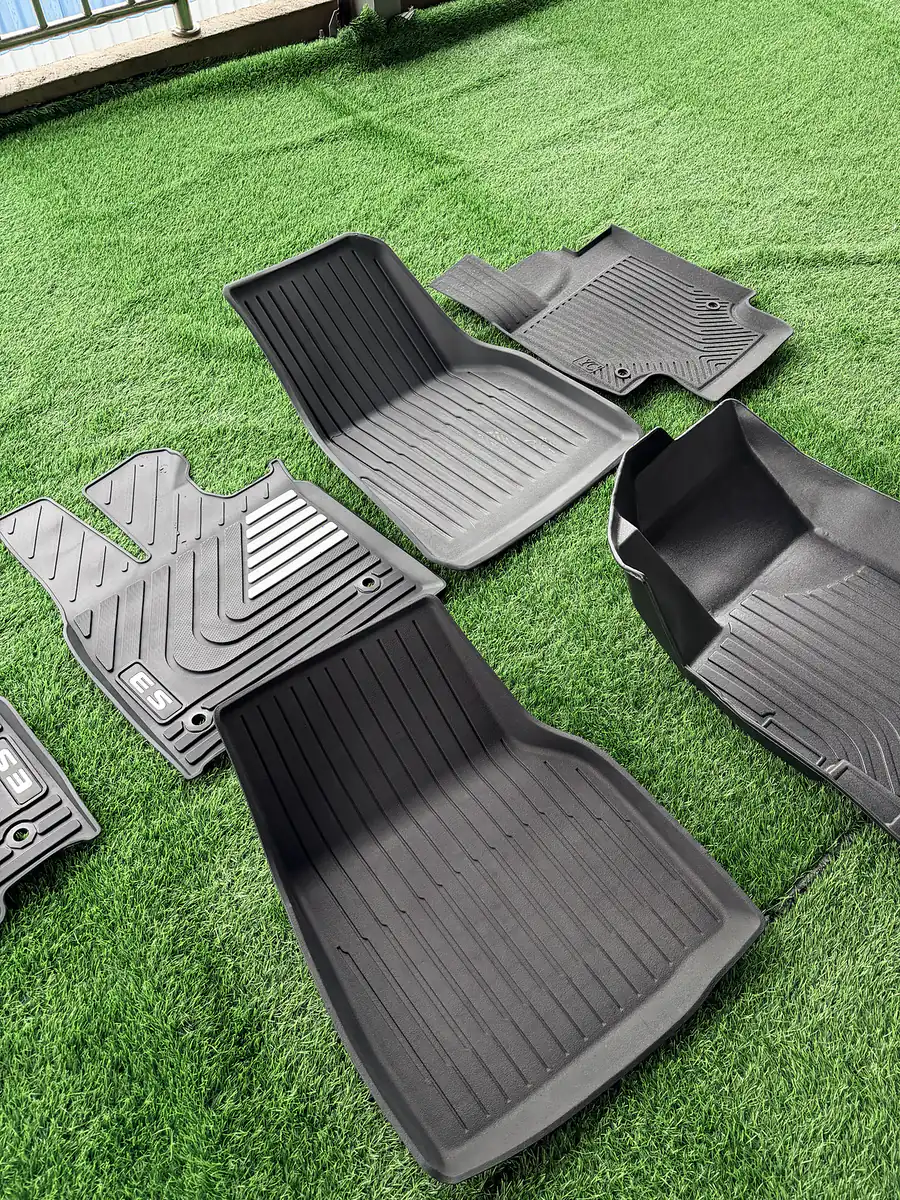
For car mats, a well-controlled injection-molded PVC compound can provide precise textures, good wear resistance, easy cleaning and stable mass production, although it is generally heavier and depends strongly on formulation control. A high-quality TPE can offer lighter weight, a rubber-like feel and good low-temperature flexibility, but premium grades may cost more, while low-cost grades can still suffer from odor and unstable performance.
How OUBIAO controls injection-molded PVC
OUBIAO MAT specializes in injection-molded PVC car mats. With more than 20 years of industry experience and 17 years of in-house manufacturing, we are experts in PVC formulation selection, mold design, surface texture, vehicle fitment and stable repeat production.
We use several controlled PVC formulations for different markets, climates, hardness levels, environmental and chemical-compliance requirements. Depending on the selected formulation, OUBIAO PVC car mats can provide strong heat and cold resistance, anti-slip performance, wear resistance and easy cleaning—all important for daily use inside a vehicle.
OUBIAO's 8,000-square-meter production workshop and warehouse are free from material odors. In contrast, persistent strong material odors are common in many factories, especially those processing low-grade flexible compounds. Selected OUBIAO car mat samples have also been screened for eight heavy metals and for lead plus seven phthalates. The exact formulation, sample and destination-market requirements must still be confirmed for every project.
PVC car mats are not as poor as many people believe. The real problem is the enormous variation between formulations and the large number of low-grade products in the market. OUBIAO does not treat PVC as the cheapest possible option; we combine formulation, injection molding and product structure as one complete quality system.
What do rubber and latex really mean?
Rubber is a broad category of natural or synthetic elastic materials, while latex is more accurately a liquid dispersion or raw-material form used to make certain rubber products. In the car mat market, however, these words are often used loosely. Many products sold as “rubber” or “latex” are actually made from flexible PVC or PVC-based compounds because buyers may not understand the technical distinction. Buyers should therefore confirm the actual compound or test report instead of relying on the marketing name.
A practical material comparison
| Material name | What it really describes | Important buyer consideration |
|---|---|---|
| Flexible PVC | PVC compound adjusted with plasticisers and other additives | Formulation quality, odor/VOC, temperature behavior, wear and processing control |
| TPE | A broad family of thermoplastic elastomers | Exact TPE family, grade, hardness, process and validated performance |
| TPV | A dynamically vulcanized type of TPE, commonly based on PP and EPDM | Whether its elasticity, heat and weather performance are required for the application |
| Rubber | Natural or synthetic rubber compound, usually vulcanized | Exact rubber type, odor, weight, aging, wear and curing quality |
| Latex | Usually a dispersion or source form used to make rubber products | Whether the finished product is truly latex-derived rubber or only uses a marketing name |
The material should also be evaluated together with the production process. An injection-molded PVC mat and a thermoformed TPE mat differ in both material and manufacturing method. Their fit, detail, thickness distribution, stability and cost cannot be explained by the material label alone.
For a fuller explanation of the process, read Why Injection-Molded Car Mats Are Better for Fit, Stability and Long-Term Quality.
Choose the product specification, not the marketing label
If you are evaluating materials for a new car mat program, send OUBIAO MAT your vehicle models, expected quantities, reference samples and destination-market requirements. We can discuss the suitable formulation, production process and product structure through an OEM/ODM project review.