
Why Injection-Molded Car Mats Are Better for Fit, Stability and Long-Term Quality
Injection molding gives OUBIAO greater control over vehicle fit, anti-slip structure, surface detail, dimensional precision and repeat production.
Reviewed by the OUBIAO MAT project team
Why the manufacturing process matters
Many car mats look similar in product photos, but their fit and stability can feel very different inside the vehicle. OUBIAO focuses on injection molding for vehicle-specific OEM/ODM car mat programs because it gives us much greater control over the product shape, dimensions, underside structure and functional details.
A common complaint with some thermoformed mats is unwanted movement during use. If the formed sheet does not follow the vehicle floor closely enough, gaps can remain around the edges or raised areas. A loose fit, combined with limited anti-slip structure, can allow the mat to shift or feel unstable underfoot.
Injection molding gives the manufacturer more control over the complete three-dimensional shape. The product is formed inside a closed mold, allowing the vehicle outline, underside structure, local thickness, edges and retention areas to be designed together. This usually results in more accurate fitment, stronger anti-slip performance and better production consistency.
Why injection molding performs better
For vehicle-specific car mats, injection molding offers several important advantages:
- More accurate fitThe molded shape can follow the vehicle floor and surrounding contours more closely.
- Better stabilityA precise outline, underside anti-slip structure and correctly designed retention areas help reduce unwanted movement.
- Higher dimensional precisionThe closed mold provides better control than stretching and trimming a heated sheet.
- More integrated detailsTextures, ribs, colored design areas and local reinforcement can be built into one product.
- Better wear resistanceOUBIAO's selected injection-molded compound and structure have shown stronger wear resistance than many thermoformed TPE mats in our product comparisons.
- Anti-slip and easy to cleanFine, consistent molded textures increase surface grip without relying on excessively deep patterns that can trap dirt.
- Faster mass productionAfter the mold and process are approved, injection molding usually provides faster finished-part output and more consistent repeat orders.
These small surface textures are difficult to reproduce with the same clarity and consistency through sheet thermoforming. Injection molding allows OUBIAO to control the texture directly in the mold, creating a surface that improves traction while remaining practical to wipe, rinse and maintain.
The main disadvantage is higher tooling investment. However, for a stable wholesale program, the mold supports a better-controlled product and more efficient long-term production.
When does OUBIAO's new injection-molded format make commercial sense?
For OUBIAO's new moderate-profile injection-molded format, we recommend evaluating tooling when the expected volume for one vehicle model reaches approximately 500 sets or more. The volume can come from an initial order or a realistic repeat-order plan.
This reference applies specifically to our new product shape. It is not a recommendation to reproduce the very high edges of a thermoformed full-surround mat through injection molding, and it is not a general threshold for every injection-molded product. Below approximately 500 sets, the buyer may find it difficult to spread the tooling investment across enough products. The final decision still depends on the vehicle, number of pieces, mold size, structure and expected program life.
For the commercial and technical information needed before tooling, see OUBIAO's OEM/ODM car mat project guide.
A direct comparison
| What the buyer receives | Injection molding | Thermoforming |
|---|---|---|
| Vehicle fit | More accurate control of the complete 3D shape | More dependent on sheet forming and trimming |
| Stability | Integrated anti-slip and retention structures | Loose areas may remain if the formed shape is not accurate |
| Precision | Higher dimensional control and repeatability | More affected by stretching and trimming |
| Product appearance | Clean, integrated details and controlled colored accents | Details are limited by the formed sheet and secondary work |
| Edge height and coverage | Better controlled for an integrated, vehicle-specific shape | Large coverage areas and high surrounding edges are easier to form |
| Mass production | Faster and more consistent after mold approval | More forming, cooling and trimming steps |
| Initial tooling | Higher investment | Lower investment |
| Unit cost at stable volume | Tooling can be spread across repeat production, reducing unit cost | Unit cost is often higher because of sheet material, forming and secondary trimming |
Thermoforming has clear advantages: the mold-development cost is lower, early samples can be prepared faster, and the process can create high edges with a large floor-coverage area. This makes it practical for small trial quantities or buyers who want a full-surround appearance without a large initial mold investment.
However, a lower mold cost does not always mean a lower finished-product cost. At stable production volumes, sheet preparation, heating, forming, cooling, trimming and other secondary work can make the unit price higher. For a serious vehicle-specific program where fit, stability, anti-slip performance, dimensional precision and repeat production matter, OUBIAO believes injection molding is the better long-term product solution.
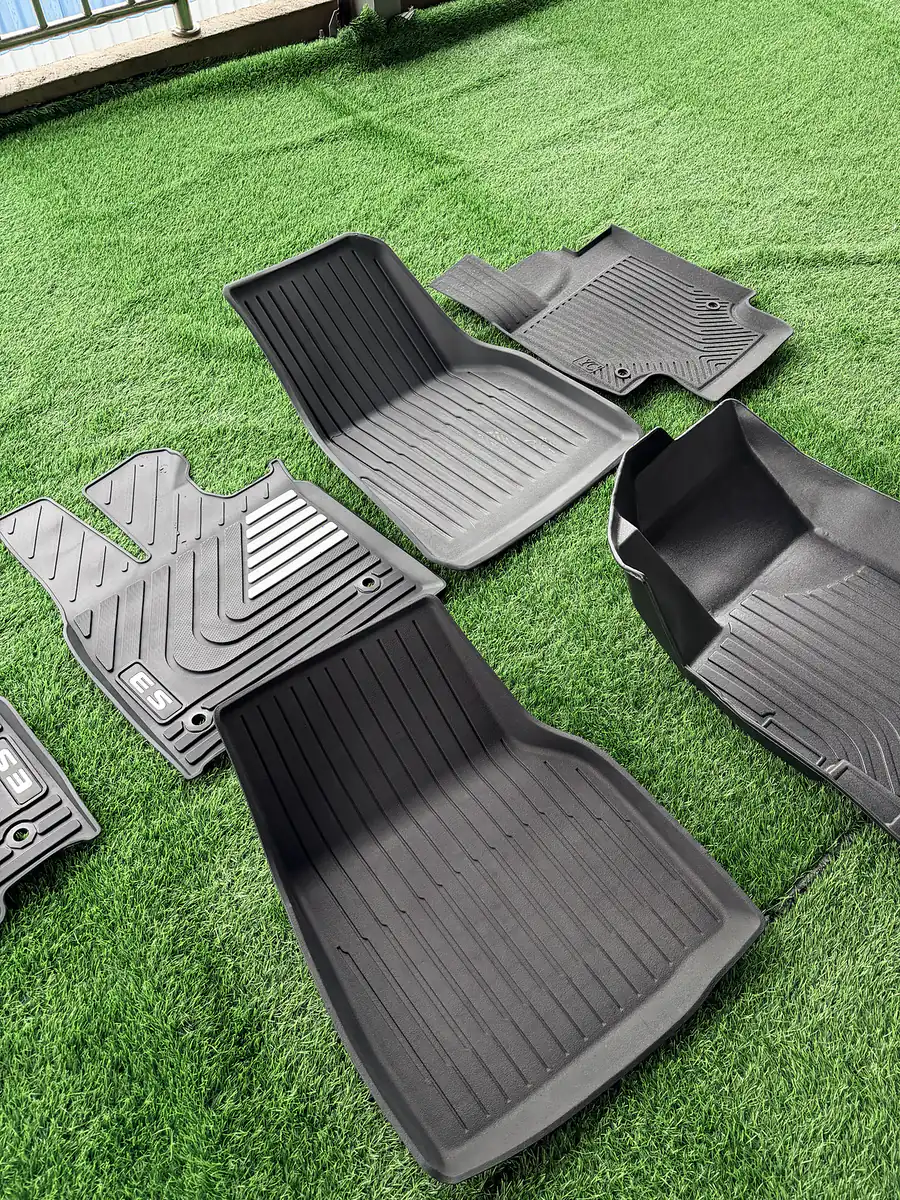
A more accessible 3D injection-molded option
OUBIAO MAT draws on more than 20 years of experience in the automotive mat industry and has manufactured automotive mats in-house for 17 years. This has given us practical experience in vehicle patterns, mold development, fitment, anti-slip structures and repeat production.
Based on our market and project experience, approximately 99% of injection-molded car mat programs use a conventional 2D structure, and most of OUBIAO's existing injection-molded production is also 2D. The remaining approximately 1% of true 3D injection-molded products usually require complex tooling, with mold investment often exceeding USD 50,000.
OUBIAO has developed a more accessible product between these two extremes. It uses injection molding and a moderate three-dimensional profile that is closer to an original-equipment interior style, without excessively high or bulky edges. It also provides accurate vehicle fitment, stable positioning, strong wear resistance, fine anti-slip textures, easy cleaning and attractive colored accents.
This new format is designed to make three-dimensional injection molding commercially accessible to more vehicle-specific programs without the tooling burden of a traditional full 3D injection mold. The actual tooling plan depends on the vehicle, set contents, mold size and structural complexity, so it should be evaluated for each project.
Manufacturing process is only one part of the decision. Read PVC vs TPE Car Mats: Why the Material Name Does Not Define Quality to understand how PVC, TPE, TPV, rubber and latex labels relate to formulation and finished-product quality, or review OUBIAO's PVC car floor mat sourcing page.
Discuss your project with OUBIAO MAT
If you are interested in this new product format, send us your vehicle models, years, LHD/RHD requirements and expected quantity for a project review and preliminary tooling discussion.